Renaissance Church Tests New Path for Church Planting
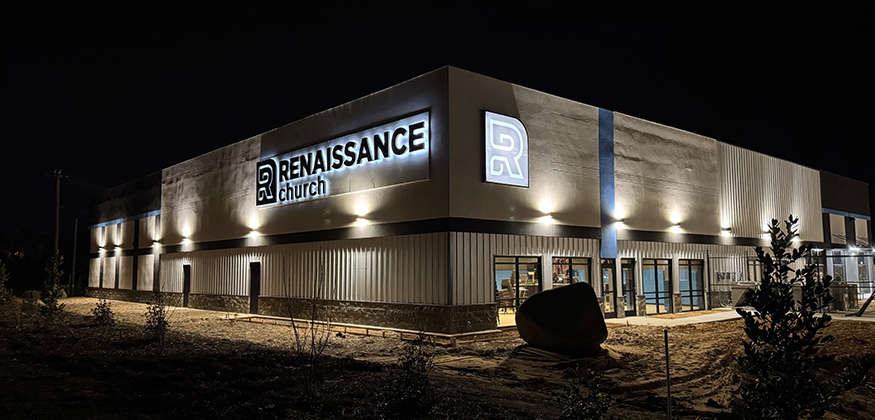
When Renaissance Church in suburban Greensboro, North Carolina, moved into its new building in mid-March, it marked more than the opening of a 700-seat sanctuary.
The church’s campus is also a test run for the expansion of Lead Pastor Jason Goins’s idea of leasing offices in church-owned co-working spaces to raise funds for more church planting.
The new campus is adjacent to the second Renaissance Place in Sedgefield.
The first began in 2022 in nearby High Point, which continues to host Sunday services; sermons are delivered by the campus pastor.
Together, the two buildings offer 80 co-working spaces, similar to a business incubator, where small businesses lease rooms from the owner. Leasing income will cover two-thirds of the church’s monthly mortgage payments while also funding church planting.
“If you had told me 20 years ago I was going to be a lawyer, a business owner, and a church pastor, I never would have believed it,” says Goins, 47. “But the Lord had different ideas.”
Goins started Renaissance Church in 2008 while working as a trial attorney. After five years, he realized he couldn’t continue in both jobs.
Six months after leaving the law firm, wife Kelley learned she was pregnant; she wanted to leave full-time employment to stay home with their newborn daughter.
“Honey, we need your income,” replied Goins, now a presbyter for the Charlotte/Triad area. “I’m making preacher money now, not lawyer money.”
“Teach me how to do real estate closings,” Kelley answered. “We can do one or two a month. That would replace my income, and I could stay home with the baby.”
Goins says the Lord “put His hand” on the endeavor, with two real estate closings growing to eight to 15 to today’s monthly average of 100.
Eventually, Kelley returned to work and is now the office manager, with three attorneys on Goins Law’s eight-member staff.
In 2022, the law office in High Point opened the door for co-working income. The building’s owner told Goins he was about to sell and suggested the church purchase it, since the building’s 30 offices could generate income.
After prayer, Goins made an offer within the church’s budget and, miraculously, the owner accepted.
A similar miracle took place in Sedgefield. After Goins’ mentor suggested moving Renaissance’s main campus closer to Greensboro because of bustling commercial development there, the pastor drove by an eight-acre plot.
He assumed the land would cost too much. However, when he checked with the real estate agent, she said the family valued it at less than a fourth of the pastor’s estimate.
The owners agreed to hold the land for a year for just $5,000 in earnest money; the pastor thought they would need to put up $100,000.
Still, Goins wondered, “How are we going to do this?” That’s when he says he sensed the Holy Spirit telling him the answer lay in High Point.
“Pitch that to the lender—that co-working is what is going to pay for this,” Goins recalls. “I talked to the bank and they caught the vision.”
However, Goins says his excitement doesn’t center on planting churches in affluent areas but on reaching the thousands who live nearby.
“If all I do is make money, I will have failed,” the pastor says. “What God would have us do is to treat this as a mission field. I think the business community is one of the most overlooked and under-appreciated sectors on the social scale.”
As part of its move to Sedgefield, Renaissance launched an outreach to entrepreneurs. Businessman and former AG pastor Rick D. Puckett is the new liaison to occupants of both Renaissance Places.
Puckett and wife Robin will have lunch and make other ongoing contacts with the 80 business owners leasing space from Renaissance Church.
“Our thought is that the professional community is an untapped mission field,” says Puckett, 66, who pastored a church plant in the area from 1999 to 2008 before returning to business.
“And it doesn’t matter where you go; many marriages are broken and people are upset and filled with anxiety,” Puckett says. “Professional women in particular are trying to balance the demands of business and home.”
Some of this kind of outreach has already been happening, says Renaissance member and coffee shop owner Jamie L. Trogdon.
The mother of three moved Tolbara Coffee and Treats to the High Point building in 2024, after operating as a mobile shop for a year.
Customers regularly ask questions about the building and are intrigued by the fact it is owned by a church, Trogdon says.
“The whole business structure in itself is a gospel outreach,” she says. “They don’t shy away from the fact it’s essentially a church-run operation, so there’s a lot of invitations and just being Jesus with skin on that happens with that.
“There’s this natural community that folks from outside the church get to experience,” adds Trogdon, 30. “Whether they understand it or not, they’re part of something bigger. You can feel the atmosphere: you’re cared for there. I think people are drawn to that.”
Goins sees vast potential in this new model. He is convinced one reason it took so long to get approvals to open its new building is Renaissance’s efforts to take ground for God’s kingdom.
“We’re going to see another wave of revival,” Goins says. “We’re already in revival, but we’re just at the appetizer stage as to where we’re going.”